
 Pascasarjana News. 14 November 2019
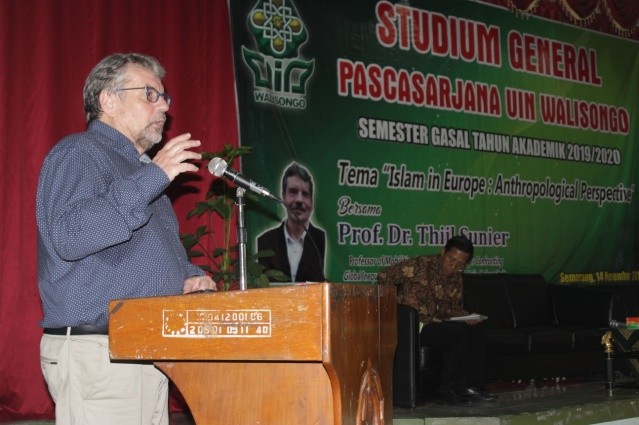
Semarang- Prof. Dr. Thijl Sunier – Professor of Mobilities, Beliefs and Belonging: Confronting Global Inequalities and Insecurities (MOBB) at Vrije Universiteit Amsterdam presented his perspective on Islam in Europe on Thursday, 14 November 2019, at Ballroom 1, Campus 1 UIN Walisongo, Semarang. According to him, Islam has become the second religion in Europe, thus making Europe not an enemy, but an opportunity. But European societies seem to consider Islam, in recent years, more a threat than an advantage. The problems European countries face is then to make these two tendencies meet, because both are true: the fact that millions of Muslims find in Europe a land of opportunity, and the fact that millions of Europeans, for good or bad reasons, fear Islam. Inevitably this process will pass through different kind of conflicts, some of which, particularly on symbolic terms, we have already seen in European societies: showing that cultural conflicts are becoming the contemporary form of social conflict.
The Muslim presence in Europe constitutes in fact a dramatic cultural change for Western European societies, particularly for the countries that only a generation ago were still exporting labour force. Furthermore, considering the tumultuous history of relations between the Islamic world and Europe, especially across the Mediterranean, the presence of Islam in Europe represents a historic watershed. If in the past one could talk of Islam and the West – cultural world that were not, but were perceived, as reciprocally independent and impermeable –, now we can speak of Islam in the West, and eventually through the role of second and third generation of immigrants and converts, of an Islam of Europe, if not yet of an European Islam.
Islam is no longer a transitory phenomenon whose presence is only temporary and can eventually be sent back ‘home.’ Nowadays, a population of about 20 million people, that can be considered ‘culturally’ Muslim, live in Western Europe, with no intention to go back. Among this population it is already difficult, now, and it will be even more difficult (and, in the end, a simple nonsense) in the future, to distinguish between the Muslims ‘of origin’, the ‘mixed’ populations, like the so-called second generations culturally grown up “between two cultures”, but also those coming from mixed marriages and families, and the ‘autochthonous’ Muslims (which include the converts to Islam, but also naturalized people). This presence has to be considered, in perspective, the new Muslim population of Europe: European Muslims, not Muslims in Europe. The future of this presence depends on many different factors and tendencies. But what is absolutely clear is that, between economic integration and political refusal, between tolerance and Islamophobia, between social mixing and mediatic hysteria, between demographic change and symbolic threats, Islam will find its place in Europe, because Muslims will do, and are already doing.
Nevertheless, this process of interrelation passes through and includes, contemporarily, encounters, clashes and reciprocal feedbacks: that rarely are analyzed and taken together into account – the most diffused option being that of underlining only one side of the medal. Probably because in the case of Islam in Europe it is a whole cultural and religious history that is implied, which has very much to do with the whole idea of the identity of Europe (in cultural, religious, historical, political terms): this is what makes this issue more sensitive and delicate than others, in terms of the possible consequences of misunderstandings.
And so every single conflict (from the ‘big’ ones concerning terrorism to the least episode of a discussion on a hijab in a single local context) ends up by looking more like a discursive substitute: a transitional object, to say it in psychoanalytic terms. The single conflict is the symptom; the illness is West’s imaginary of Islam: which, like the Islamic imaginary of the West, appears more and more conflictual. But this is only the first half of the argument, the most immediate. The second is that Islam is in its turn a transitional object: which represents and signifies the pluralization of society, and in particular, religious (and cultural) pluralism. Islam has become the discursive substitute for important changes in society, which are not tied generically to religious pluralism as such: in concrete terms they are called gender roles, clothing codes, family models, parent authority, ideas of modesty, purity, sacredness, as far as the relationship between religion and politics, religion and democracy, religion and state. Subjects that in secularized societies it has become more difficult to discuss (also) in religious terms: and that cultural and religious pluralism are bringing into the limelight.
Islam – rightly or wrongly (other diversities are often much more ‘other’) – has recently become the most extreme example of diversity and of the changes that diversity brings to European societies. These changes do not only come from Islam and Muslims. However, Islam, because of its symbolic overload and the problematic history that joins it to Europe, because of the striking and formidable aspect of some of its contemporary manifestations (among which obviously the emergence of transnational Islamic fundamentalism and terrorism), but also because of the significant statistical dimension of its presence, is inevitably at the center of the political and social debate in Europe. And it will be there for a long time. In the meantime, Islam has become the second religion, or the first of the non-Christian minorities, in all European countries. So, it will be impossible from now on to understand Europe without taking into consideration its Muslim component; but at the same time, it will be impossible to understand Islam without taking into consideration its European and Western component. Islam has become a European fact and its internal component. And Europe has become an internal fact of Islam. It is not something that is going to happen in the future. It has already happened. We have to begin to understand its consequences. Scientist should help the society explaining this phenomenon objectively. This studium generale did this task through anthropological point of view.
In general, this studium general has achieved an educational, interdisciplinary and communicative goals, namely: (1) Students have learned to see human cultures – whether in texts, religious rituals, or political or economic behavior from an anthropological perspective. These insights could be applied both to cultures separated from students’ own cultures by time or space as well as their own cultures; (2) Students have learned that anthropology as a discipline has a strong commitment to issues of social justice; and (3) Students have understand the process of anthropological interpretation and representation (MF 17/11/2019).